For those that know the process with Viome, you’ll be a bit bored here in the intro. For those that are unfamiliar, I’ll keep it quick.
For the Full Body Intelligence test, you take a saliva, blood, and stool sample from the comfort of your home. Viome recommends getting the saliva and blood on the same day, within an hour or so of waking up. For the stool sample, they want it within 3 days of the saliva and blood samples. I was fortunate and completed all of my samples within an hour-ish of waking up.
Many kudos to Viome – they do make the kit pretty easy to follow with instructions and gear. It was not overly complex to complete. The kit also comes with a pre-labeled envelope for your samples. For ultimate convenience, you can schedule with USPS for a pick up from your front door.
It took about one full month from when I took my samples to receiving my results. I got an email saying my results are ready, but nothing in the email itself (not that I bothered with it – just straight to the app to see the data).
Oh, as a biological female, I think it is important to note that Viome recommends taking samples after menstruation is completed. I do wonder if the phase of the cycle has any influence on test results, such as are saliva results different in follicular versus luteal. But that’s a different tangent for another day…
Viome Results
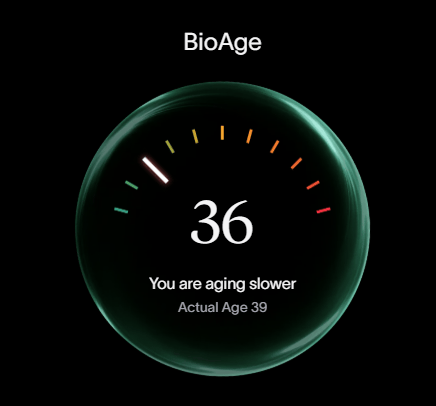
When first logging into the app and clicking to see the results, Viome walked me through some selected “health zones” with scores. Scrolling down, I saw my BioAge is 36 and indicates I am aging slower than my actual age (one small win). However, my “Inflammaging” is rated high. There are links to get to know my Microbiome profile and then how my health scores reveal connections to health conditions.
When I clicked to view my health scores, Viome lists 59 different areas with an associated score. I click into each of those scores to learn about the area itself and, depending on my personal score, any insights from my samples and analysis.
Health Scores
Here’s where things started to get overwhelming – 59 areas. I scored under 70 on 52 of them… If you’re doing the math, that means I had seven (7) areas where I scored 70 or above.
As someone that was an honor student, I was not impressed to see so many failing scores. It would appear that any score 60 and above results in a Maintain grade from Viome. Don’t get excited, this only changed in about 12 more areas to my original seven. A grand total of 42 areas resulting in Improve or Attention.
| Maintain | Improve | Attention |
| 17 | 21 | 21 |
When 21 health areas result in Attention, I don’t quite feel like my body is aging slower than my actual age. It is hard to accept this is the state of my biology, but — this is important data. In four to six months, we’ll test again and see if changes from this test result in a shift.
This is where being an engineer (and self-proclaimed biohacker) comes in handy. We’re not just going to measure by a “how am I feeling” or “did I lose weight” – a follow up Viome test will show if following their recommendations indeed results in improved results.
Another point of kudos to Viome is that I liked the ability to export the scores to .csv format. Sorting the values there helped me prioritize where to start – at the lowest scores.
| Score of 30-35 | Score of 20-29 | Score of 10-19 | Score of 1-9 |
| 6 | 8 | 2 | 5 |
I had five health areas with a score of 9 or lower, so in my initial days of digesting the data (pun intended, I suppose), I decided to focus my initial efforts on those five areas. I’m not going to put out the details, as that is hard work Viome puts together. However, the highlights from my results indicated slow digestion, insufficient vitamin D levels, gum health issues, and elevated ammonia production in the gut.
With its results, Viome links to recommendations for improving the score, like food and probiotic strains. It also links the health area to a health connection. Using ammonia production as an example, it lists 10 food and ingredient suggestions and related health conditions like IBS Type-C, Type 2 Diabetes, or Kidney Disease.
It’s important to note – Viome is not making a health diagnosis with these “connections.” These are flagged by patterns they’ve seen in their data. I have not been diagnosed with Type 2 diabetes, and my blood glucose actually trends in healthy patterns. I do show signs of insulin sensitivity in other areas I’ve tracked, which could correlate with why Viome is flagging it.
Nutrition Results
When I look at nutrition, Viome lists superfoods to boost my health daily, foods I should diversify my diet with daily, foods that I should minimize to a single daily serving, and foods I should avoid completely for six months. This is where things got even more interesting…
Out of 373 food options:
- 58 are superfoods
- 186 foods can be enjoyed daily
- 89 foods should be minimized
- 40 foods avoided for six months
Let’s start with the elephant in the room – 40 suggested foods to entirely avoid for 6 months (including holidays like Thanksgiving and Christmas). One can hope they are foods you don’t like, but chances are high for me that many of those foods are actually things I enjoy on a daily basis. The odds were not in my favor. From a quick count, I enjoy about 13 of those “avoid” foods (more than 25%) almost daily – to include beef, broccoli, brussels sprouts, lamb, lemon, and turmeric. I saw these “avoid” suggestions and just about discounted the whole Viome experience. I definitely had the “is this worth it” questioning moment.
Foods I literally eat on a daily basis could be hurting my biology.
Action Plan
Starting this week, I’m going to do my best to eliminate the “avoid” foods. I do think this will be the most challenging part of the journey. It is one thing to know you should stop eating sugar, but it’s a complete game changer when your goal becomes removing grass fed steak and organic broccoli from your menu planning. I’m going to use a streak tracker app to see how long I can go without beef, broccoli, and brussels sprouts. Only about 120 days to go!
I am using AI to help me analyze the results and learn more beyond just Viome’s recommendations or descriptions. I say this recognizing AI can get things wrong, but I find it helpful to work out thoughts and build a log of ideas, etc. I’m not a wizard at using AI, but I recognize it has an ability to help a user. Like any tool, you have to have some knowledge to wield it and be willing to get cut if you make a mistake.
In my first dialog with AI on my Viome results, I did ask it to make a spreadsheet of my food recommendations. I wanted something I could filter and easily work with compared to searching the app or printing off 7 pages of data. I also asked a little more about my gas production pathways and if certain supplements could help.
With beef and buffalo flagging in my “avoid” list, I also asked if my organ supplements should be suspended for 6 months; I asked this of the Viome AI chatbot too. Both AI tools recommended pausing my organ supplements, which I found interesting. Naturally, I’m going to pause and give this “avoid” experiment the discipline it deserves, but I’m bummed to give those up.
My last question for AI was how to use this new list of foods to develop a one day meal plan. Rebooting my brain from something like this:
- Pre-breakfast: lemon water with electrolytes
- Breakfast: eggs, bacon, bulletproof coffee
- Lunch: salmon, asparagus, avocado
- Dinner: ribeye, brussel sprouts
To:
- Pre-breakfast: water with electrolytes
- Breakfast: chia pudding, bulletproof coffee
- Lunch: salmon, sauteed spinach and mushroom
- Dinner: chicken, chard, celery
I’m not sure how this will look over time, but I’ll take you along for the experience.
Disclaimer: The content on BioRebuild is for informational and educational purposes only and reflects my personal experiences and research. It is not medical advice and is not intended to diagnose, treat, or prevent any disease. Individual results may vary. Always consult a qualified healthcare professional regarding your personal health concerns before making changes to your diet, supplements, medications, or treatment plan.


Leave a Reply